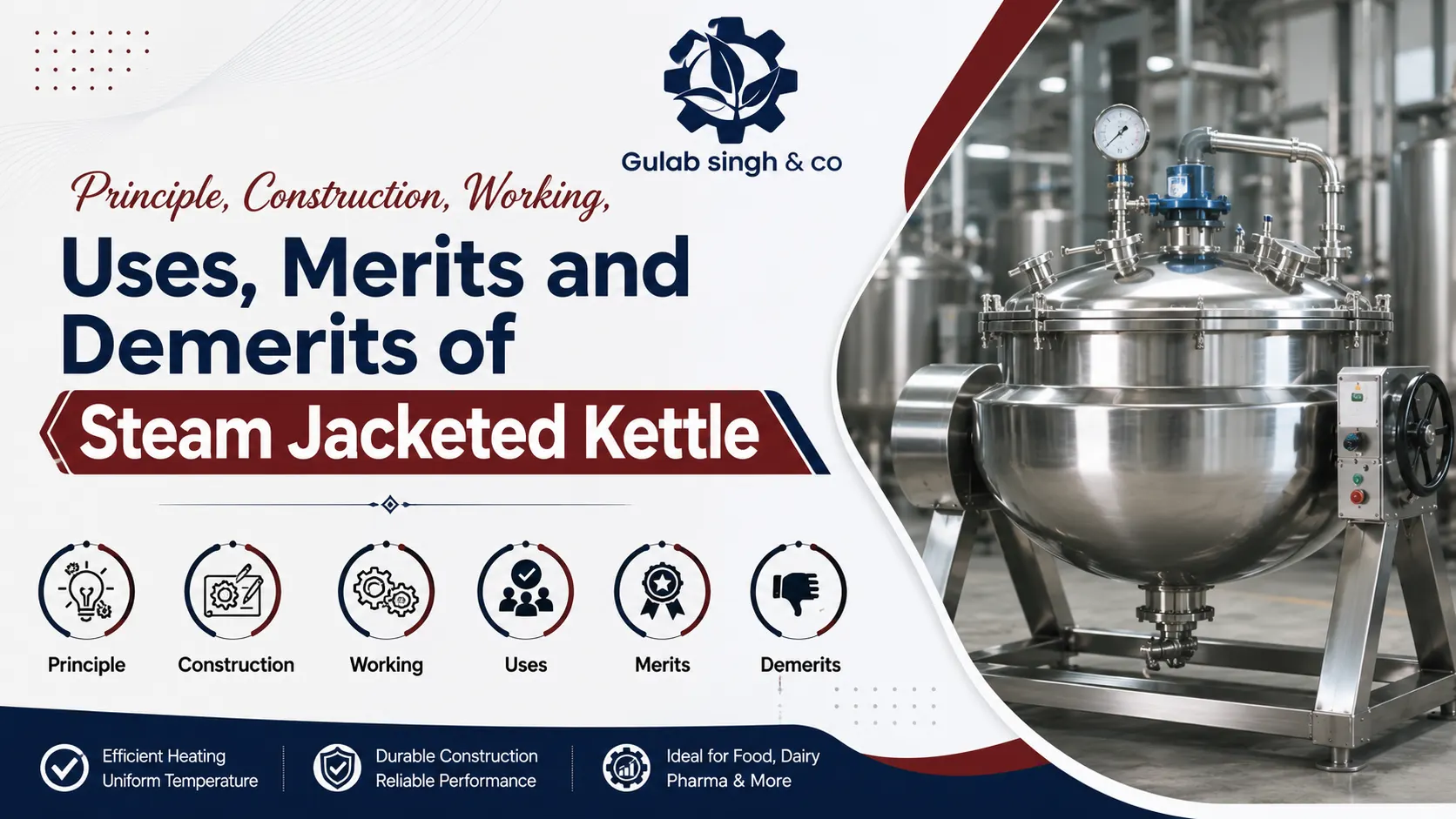
Gulab Singh & Company offers efficient food processing equipment designed to support commercial kitchens and industrial manufacturing units. Among the important equipment used for large-scale heating and cooking operations, the steam jacketed kettle is widely preferred for preparing sauces, gravies, soups, jams, syrups, dairy products, and other liquid or semi-liquid materials. It provides indirect and controlled heating, which helps improve product quality while reducing the risk of localized burning.
A steam jacketed kettle is commonly used in the food, dairy, pharmaceutical, chemical, and beverage industries where controlled heating and uniform temperature distribution are important. The equipment is designed with a specially constructed vessel surrounded by an outer heating chamber.
Steam Jacketed Kettle Principle
The steam jacketed kettle principle is based on indirect heat transfer. Instead of allowing a direct flame or heating source to come into contact with the product, steam is introduced into the outer jacket surrounding the inner vessel. The steam transfers heat through the metal wall of the kettle and gradually heats the material inside.
The main principle depends on condensation and heat transfer. When steam enters the steam jacket, it contains a large amount of thermal energy. As the steam comes into contact with the cooler metal surface surrounding the inner vessel, it condenses and releases its latent heat. This heat passes through the vessel wall and is transferred to the food product or other material.
Construction of Steam Jacketed Kettle
The construction of a steam jacketed kettle generally consists of an inner vessel and an outer jacket. The inner vessel holds the product, while the outer chamber allows steam to circulate around the vessel.
Important parts of the equipment may include:
- Inner cooking vessel
- Outer steam jacket
- Steam inlet connection
- Steam outlet or condensate outlet
- Pressure gauge
- Safety valve
- Temperature monitoring arrangement
- Lid or cover
The steam jacket is an important part of the equipment because it creates a space between the inner and outer walls where steam can circulate. The jacket may cover the sides and bottom of the kettle to provide efficient heat transfer.
Steam Jacketed Kettle Working
The working process begins when steam is supplied to the outer jacket through the steam inlet. The steam circulates around the outside of the inner vessel and transfers heat through the metal wall. The material placed inside the kettle absorbs this heat and its temperature gradually increases. As steam transfers heat, it condenses into water. The condensate is then removed through a suitable outlet system.
The operator can monitor the process using suitable controls and temperature or pressure indicators. When the product reaches the required condition, it can be discharged manually or through a tilting or outlet mechanism. A properly selected steam jacketed kettle helps create a more controlled heating process and supports efficient production.
Steam Jacketed Kettle Diagram
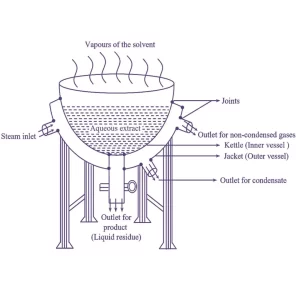
A typical steam jacketed kettle diagram illustrates the basic arrangement of the equipment. It generally shows the product-holding inner vessel surrounded by the outer steam jacket. The diagram may also include the steam inlet, condensate outlet, pressure gauge, safety valve, lid, and supporting structure.
The basic flow can be understood as:
Steam Supply → Steam Inlet → Steam Jacket → Heat Transfer Through Vessel Wall → Product Heating → Steam Condensation → Condensate Outlet
Steam Jacketed Kettle Uses
The wide range of steam jacketed kettle uses makes this equipment valuable across many industries. It is commonly used for heating, cooking, boiling, mixing, and processing liquid and semi-liquid materials.
Common applications include:
- Preparation of sauces and ketchup
- Cooking soups and gravies
- Production of jams and fruit pulp
- Preparation of syrups and sugar solutions
- Dairy product processing
- Cooking food products in commercial kitchens
- Pharmaceutical product processing
- Chemical processing applications
A steam jacketed kettle can be used where uniform heating is necessary for achieving consistent product quality. The equipment may also be designed with additional features according to specific production requirements.
Merits of Steam Jacketed Kettle
One of the major merits of a steam jacketed kettle is indirect heating. Since the product is not directly exposed to a flame, there is less chance of excessive localized heating when the equipment is properly operated.
Other advantages include:
- Uniform and controlled heat transfer
- Suitable for a wide range of food products
- Reduced risk of direct flame contact
- Available in different capacities
- Can support batch processing
- Suitable for liquid and semi-solid materials
- Easy integration with steam-based heating systems
- Can be fitted with an agitator
The use of steam can also provide effective heat transfer when a suitable steam system is available. For manufacturers already operating boilers or central steam systems, a steam jacketed kettle can become a practical part of the production line.
Demerits of Steam Jacketed Kettle
A steam jacketed kettle also has certain limitations. One of the main requirements is the availability of a suitable steam source. This means the facility may require a boiler or another appropriate steam generation system.
Other limitations may include:
- Initial installation can require significant investment
- Requires a steam generation and supply system
- Regular maintenance is important
- Improper operation may lead to uneven heating
- Pressure safety measures are necessary
- Condensate handling is required
- Skilled operation may be needed for industrial systems
The selection of the right capacity and configuration is important to obtain the best performance from the equipment.
Why Choose Gulab Singh & Company?
Gulab Singh & Company understands that every food processing operation has different requirements. Production capacity, product characteristics, heating requirements, and available utilities should all be considered before selecting processing equipment. We offer suitable steam-based processing solutions designed to support efficient heating and cooking operations. A properly designed steam jacketed kettle can help manufacturers improve process control and maintain consistent production results.
From understanding the steam jacketed kettle principle to selecting the right construction and capacity, businesses should evaluate their requirements carefully. With suitable equipment and proper operation, a steam jacketed kettle can provide dependable indirect heating for a wide range of industrial and commercial applications. Gulab Singh & Company offers practical machinery solutions to help food manufacturers improve their processing operations. The equipment can be selected according to specific production needs, helping businesses achieve efficient, hygienic, and consistent heating results.