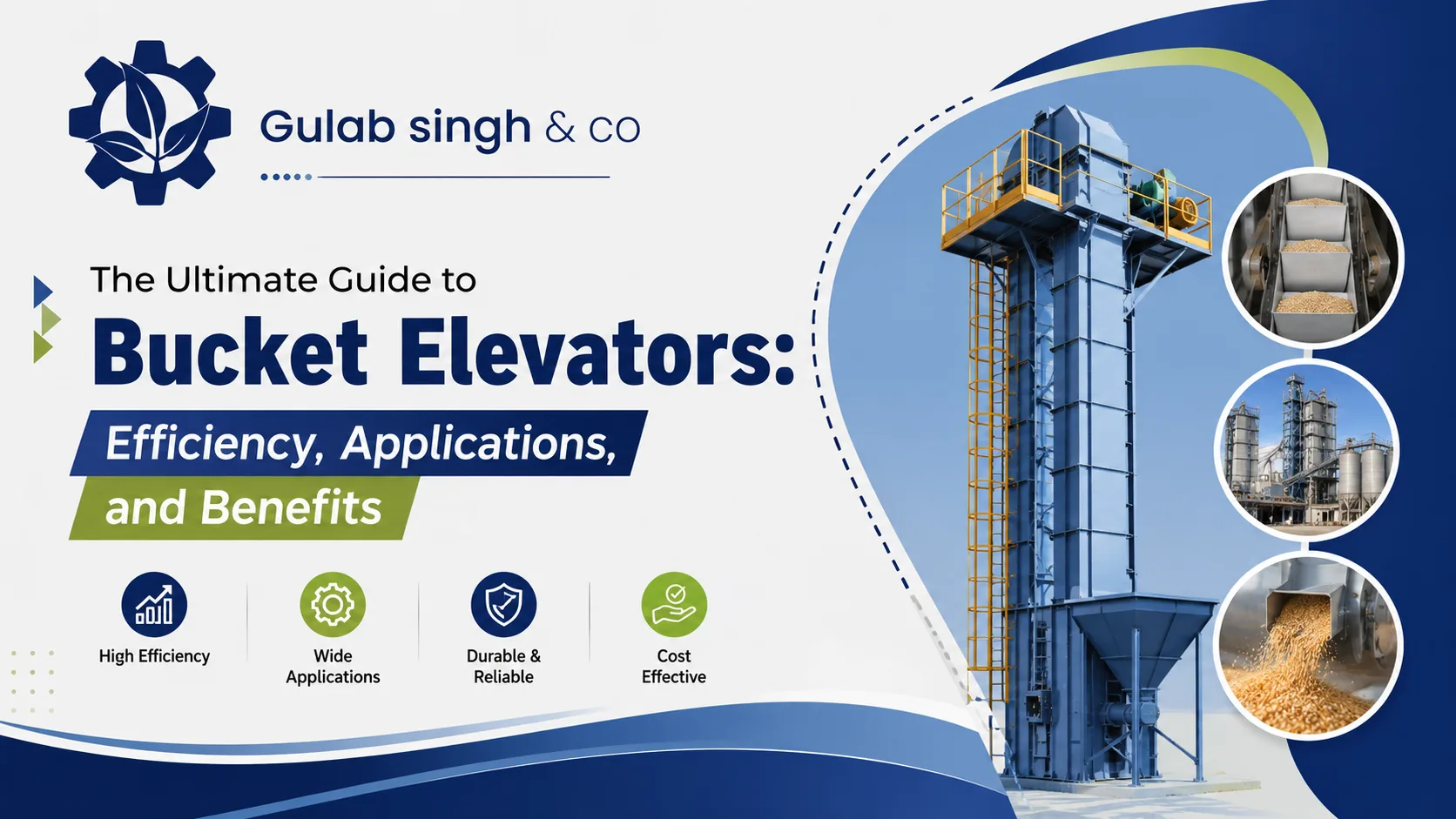
Among the many material conveying systems available today, bucket elevators remain one of the most reliable and cost-effective solutions for vertical transportation of bulk materials. From agriculture and food processing to cement, mining, and chemical industries, bucket elevators play a vital role in moving materials safely and efficiently.
A properly engineered system, supported by effective Bucket Elevator Design, can significantly improve plant performance while minimizing downtime and maintenance expenses. At Gulab Singh & Company, we offer high-quality bucket elevator solutions tailored to the unique needs of different industries.
What is a Bucket Elevator?
A bucket elevator is a mechanical conveying system designed to transport bulk materials vertically using a series of buckets attached to a belt or chain. The buckets scoop material from the loading point, carry it upward, and discharge it at the desired destination. bucket elevators require less floor space and can transport large volumes of material over significant heights with remarkable efficiency.
How Does a Bucket Elevator Work?
The operation of a bucket elevator is relatively simple yet highly effective.
The process generally involves:
- Material enters the elevator through the boot section.
- Buckets attached to a belt or chain collect the material.
- The drive system moves the buckets upward inside the enclosed casing.
- At the head section, centrifugal force or gravity discharges the material.
- Empty buckets return to the loading point for the next cycle.
The efficiency of this process largely depends on proper Bucket Elevator Design, including bucket configuration, drive mechanism, discharge arrangement, and material characteristics.
Importance of Bucket Elevator Design
A successful material handling system starts with intelligent Bucket Elevator Design. Poorly designed systems can lead to excessive wear, material spillage, reduced capacity, and costly downtime.
Key objectives of proper design include:
- Maximizing conveying efficiency
- Reducing energy consumption
- Minimizing maintenance requirements
- Preventing material degradation
- Enhancing operational safety
- Improving equipment lifespan
At Gulab Singh & Company, we provide customized engineering solutions that ensure optimal performance under varying operating conditions.
Benefits of Bucket Elevators
- High Conveying Efficiency: Bucket elevators can transport large volumes of material vertically with minimal energy consumption, making them highly efficient for industrial applications.
- Space-Saving Design: Unlike inclined conveyors, bucket elevators require a smaller footprint, making them ideal for facilities with limited floor space.
- Reduced Material Loss: Enclosed elevator casings minimize dust generation and material spillage during transportation.
- Low Operating Costs: Efficient power usage and durable construction contribute to lower operating expenses over time.
- Versatility: Bucket elevators can handle a wide variety of materials ranging from fine powders to heavy bulk products.
- Long Service Life: When combined with proper maintenance and quality Bucket Elevator Design, these systems provide years of dependable service.
Types of Bucket Elevators
Bucket elevators are available in different designs to suit various materials, capacities, and industrial applications. Choosing the right type is essential for ensuring efficient material handling, minimizing product loss, and improving overall system performance.
1. Centrifugal Discharge Bucket Elevators
Centrifugal discharge bucket elevators are among the most widely used systems in industrial applications. They operate at high speeds, allowing the material to be discharged from the buckets by centrifugal force as they pass over the head pulley.
2. Continuous Bucket Elevators
Continuous bucket elevators are designed for gentle material handling. In this system, buckets are positioned close together, allowing material to flow from one bucket into the discharge chute without being thrown by centrifugal force.
3. Positive Discharge Bucket Elevators
Positive discharge bucket elevators use specially designed buckets mounted on chains. The buckets are mechanically guided during discharge to ensure complete emptying of the material. These elevators are ideal for handling sticky, sluggish, or difficult-to-discharge materials that may cling to standard buckets.
4. Belt Bucket Elevators
In belt bucket elevators, the buckets are attached to a continuous belt that rotates around pulleys. These elevators are commonly used in medium-duty applications where smooth operation and energy efficiency are important.
5. Chain Bucket Elevators
Chain bucket elevators use one or two chains instead of belts to move the buckets. These systems are designed for heavy-duty applications involving abrasive, hot, or high-density materials.
6. Industrial Heavy-Duty Bucket Elevators
Heavy-duty bucket elevators are specially engineered for demanding industrial environments where large quantities of material must be transported continuously. These elevators are commonly installed in cement plants, mining facilities, fertilizer plants, and bulk material handling operations.
7. High-Speed Bucket Elevators
High-speed bucket elevators are designed to maximize throughput by operating at greater belt or chain speeds. They are primarily used in facilities where large quantities of free-flowing materials must be transported quickly.
8. Low-Speed Bucket Elevators
Low-speed bucket elevators are specifically designed for fragile materials that require careful handling. These systems are frequently used in food processing, seed handling, and specialty chemical industries.
Also Read : What Are The Steps In Instant Noodles Manufacturing?
Bucket elevators are one of the most efficient solutions for vertical bulk material transportation. Our ability to handle large capacities, operate within limited space, and deliver reliable performance makes them indispensable across numerous industries. However, achieving maximum efficiency depends greatly on proper Bucket Elevator Design, careful equipment selection, and regular maintenance.
At Gulab Singh & Company, we offer expertly engineered bucket elevator systems designed to meet modern industrial demands. Whether for agriculture, food processing, mining, cement, or chemical applications, a well-designed bucket elevator can significantly enhance operational efficiency and contribute to long-term business success.